
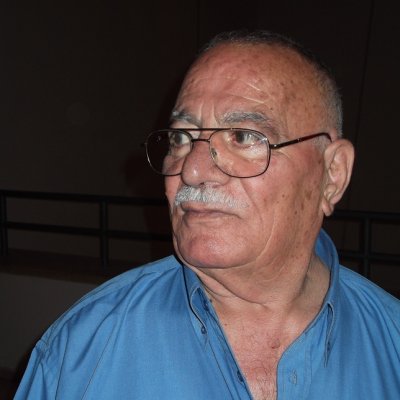
Jamal Bannoura
جمال بنورة
Jamal Bannoura was born in the town of Beit Sahour, near Bethlehem, into a Greek Orthodox Christian family. He had one son named Hamdi. He went to primary and secondary school in Beit Sahour and Bethlehem, and he earned his high school diploma in 1957. He worked as a schoolteacher in Beit Sahour and in the town of al-Eizariya, two kilometers east of Jerusalem.
Bannoura began his literary career in the early 1960s by writing short stories, influenced by the trend of socialist realism prevalent in the Arab world at the time. He then switched to writing novels and plays and emerged as one of a group of Palestinian writers of the same generation known as al-Ufuq al-Jadid, or the New Horizon group, named after the Jerusalem-based literary magazine edited by Palestinian poet Amin Shunnar published from 1961 to1966. Some of the other writers who were part of this group were Mahmoud Shuqair, Khalil al-Sawahiri, Majid Abu Sharar, Mohammad al-Batrawi, and Jamil al-Salhout.
Bannoura described that early phase in his literary career:
Pre-1967 can be called my beginning period. It had two distinguishing features: the first was that I immersed myself in intensively reading both Arabic literature and the masterpieces of world literature translated into Arabic; second, it was during this period that I made my first attempts at writing. At that stage, I was still learning to write from what I read; the more I read, the more I tried to write. At the same time, in spite of several attempts, I did not manage to get a single short story accepted for publication for five whole years. It got to the point that I began to doubt myself and wonder: Am I really a writer or just a loser who has delusions of being a writer? I decided to quit writing, but then my wife encouraged me, saying: What you write is much better than a lot of what gets published in newspapers and magazines, and the time will come when you will be recognized as a writer. This was also the opinion of some of my friends, so I went back to writing with even greater gusto. It was not long before the doors to the world of publishing opened up for me, and I became associated with the contributing writers in al-Ufuq al-Jadid.
The June 1967 defeat marked a turning point in Bannoura’s career as a writer, leading him to commit himself to the Palestinian resistance. His writing began to depict the struggle for national liberation and the steadfastness of Palestinians and their resistance against the Israeli occupation, as well as addressing the everyday problems of Palestinians living under occupation. He says that this second period of his literary career as a writer represented “a major milestone in my creative journey and the beginning of a new literary phase in which I chronicled the life of the Palestinian people living under occupation. Before 1967, I was trying to find a subject to write about; after the occupation, I had an abundance of subject matter to write about, so during this period, I published four short story collections, two plays, as well as the novel Ayyam la tunsa (Unforgettable Days), which deals with the 1967 war and what ensued.”
Bannoura published his short stories under a pseudonym in newspapers and magazines affiliated with the Communist Party in Haifa, such as al-Ittihad and al-Jadid. These stories were later gathered in a collection titled al-Awda (The Return), published by the Jerusalem-based Salah al-Din press; it was one of the first short story collections published inside the Palestinian territories occupied in 1967. He also worked as an editor for the culture page of the weekly newspaper al-Taliʿa, which was published in Jerusalem but banned from distribution in the occupied West Bank and Gaza Strip. He also published short stories in other Palestinian newspapers and magazines such as al-Fajr, al-Shaʿb, al-Fajr al-Adabi, al-Bayadir and al-Katib. He also wrote the aforementioned novel Ayyam la tunsa which deals with the period of the 1967 war and the emergence of the Palestinian resistance movement. The novel was critical of the Arab regimes and revealed the sense of defeat that had befallen them.
Bannoura was active in clandestine work against the occupation and lived for a while on the run as a fugitive from the occupation authorities. In April 1976, he ran as a candidate in the municipal elections of Beit Sahour heading a list of candidates that called itself the Youth Bloc (kutlat al-shabab), which campaigned under the slogan “Yes to the PLO and no to the [Israeli-led] Civil Administration.” He did not win a seat on the municipal council, although the Youth Bloc that he belonged to won a council seat for one of its members, Attallah al-Rishmawi, who was imprisoned by the occupation at the time.
In 1977, Bannoura took part in establishing the al-Bayader Writers Union, named after the magazine that had just been founded by Jack Khazmo in Jerusalem. Then, in 1978, along with fellow Palestinian writers Mohammad al-Batrawi and Ali al-Khalili, Bannoura was elected to the administrative committee of the Writers’ Circle of the recently established Arab Thought Forum (al-Multaqa al-Fikri al-Arabi) in Jerusalem. When the cultural magazine al-Katib was founded by Palestinian writer Asʿad al-Asʿad, who acted as both its owner and editor-in-chief, Bannoura joined the magazine’s board of editors. He was also one of the co-founders of the League of Palestinian Writers in the Occupied Territories (Jamʿiyyat al-Kuttab al-Filastiniyyin fi-l-Aradi al-Muhtalla) which subsequently merged into the General Union of Palestinian Writers and Authors after the establishment of the Palestinian National Authority (PA) in 1994, and he was elected to sit as a member on its governing board.
Bannoura was to taste the experience of detention in the occupation’s prisons. He was jailed in al-Faraʿa military detention center northeast of Nablus, in al-Dhahiriyya prison near Hebron, and in Ketziot, a military detention camp in the Negev (popularly known by the Palestinians as Ansar-3, after Ansar, a detention camp established by the Israeli army in South Lebanon in Summer 1982). He gave creative expression to these experiences in several of his short stories, including a novella about his stint in al-Faraʿa, which began to be used by the occupation authorities as a detention center in the early 1980s, with the upturn in popular uprisings against the occupation. In 1983, Bannoura was forced by the occupation to retire from his job as a schoolteacher.
Bannoura participated in the first intifada that erupted in December 1987 and in the acts of civil disobedience that the residents of Beit Sahour came to be famous for during that uprising. He considered the intifada to be the beginning of the third stage of his literary career:
The literature of this time period was called ‘intifada literature,’ and the Union of Palestinian Writers sponsored the publication of several short story collections, collections of poetry and a number of novels about the intifada. Among these were two of my short story collections published at the time, as well my novel Intifada. The novel’s plot and characters were inspired by the daily events and confrontations that I either saw, heard about or directly participated in, especially the extraordinary battle waged by Beit Sahour through its civil disobedience in refusing to pay taxes [to the occupation authorities]. The novel was also inspired by my experience in prison in al-Dhahiriyya and the Ansar-3 detention camp in the Negev, and it documents the prison rebellion that occurred in the latter in [August] 1988, during which two young detainees were martyred and dozens more injured.
Bannoura finished writing Intifada in 1996, and the novel was published by al-Shuruq Press in Amman in 1998. The novel had already been published in serial form in the Ramallah-based newspaper al-Ayyam from 12 December 1996 to 27 March 1997.
The fourth stage of Bannoura's literary career began after the establishment of the PA. During this period, he wrote a novel titled Wa mā zāla al-hulm! (And the Dream Lives On!), in which he attempted to shed light on the new reality under the PA and to envision what the future held, posing many urgent questions. The novel was eventually published in 2010 by al-Namir Press in Syria. He also wrote a play titled al-Hayat wa-l-mawt (Life and Death), which was an attempt to delve into the world of the dead, revealing its secrets and the peculiar goings-on it conceals. He wrote a set of short stories set in the Second Intifada after it erupted in 2000, which was published in 2006 as a collection titled Mawt al-fuqara (The Death of the Poor). He also wrote a play titled al-Hulm wa-l-haqeeqa (Dream and Reality), which depicts a young man who became physically disabled during the Intifada, which restricted his mobility and prevented him living the normal life he wished, but nevertheless not losing hope for the future.
Bannoura was deeply interested in the folkloric heritage of his hometown. He collected as much of it as he could, including recording the lyrics of the samer songs local to Beit Sahour (a kind of oral folkloric poetry native to Palestine, often sung and accompanied by collective dance). He wrote of his research in a monograph titled Outside the History Books: A Field Study of Palestinian Folkloric Heritage, published in 2016 by Kull Shay Books in Haifa. This study explored the traditional architecture and cultural heritage of Beit Sahour in its various manifestations, such as its traditional and patriotic folk songs and poetry, popular aphorisms, and customs related to death, burial, and mourning ceremonies. He once commented, “When I research [our] cultural heritage and folklore—in order to transcribe it and save it from being lost—I feel as if I am searching for myself. This is what has encouraged me to carry on, the sense I have that cultural heritage and folklore represent a person's national identity and help to strengthen their sense of feeling grounded in their family–both in the immediate and extended sense–as well as their homeland.”
Bannoura’s play al-Hayat wa-l-Mawt (Life and Death) was awarded a prize by the PA’s Ministry of Culture in 1995. Some of his short stories have been translated into several other languages, including English, German, Bulgarian, and Spanish, in addition to two entire short story collections that have been translated into Russian and Italian.
In an interview, Bannoura was asked about how he conceived of commitment and what he generally wanted to offer through his literary work. He replied:
I do not intend for any of my literary works to be read simply as ideological tracts. I am depicting the reality we are living in; I’m not saying this to defend myself against any accusations directed at me, for writers have the right to write whatever they want. However, I do want to clarify one point. I am not concerned with giving any particular aura to the protagonists of my stories and novels, and portraying them in a way that may not suit them, nor would it appeal to many. What I care about is to portray my characters as they actually are, in real life. As for how to conceptualize commitment, for me it means to write with honesty and integrity in portraying the lives of the popular masses, and to stand by them in fighting for the issues they face in their everyday lives, along with their national and political causes. If I am not committed to the causes of our people and in fighting for them, then what am I doing as a writer?”
Palestinian writer Mahmoud Shuqair described commitment in Bannoura's fiction in the following way: What predominates in Jamal Bannoura’s short stories is that they bring to the fore the positive values that are constitutive elements in a Palestinian reality whose lives are concerned with struggle, resistance, sacrifice and remaining steadfast, and a sense of being closely attached to the land in the face of the occupation, both in the tangible and intangible sense of the word. Shuqair emphasized that Bannoura does not express these themes directly, because a literal expression of them would void the short story of its aesthetic and literary value, given that it is above all a creative work, not a set of slogans. This is crystal-clear in Bannoura’s short story “al-Shayʾ al-mafqud” (The Lost Item), the eponymous story of his collection from 1982. In this story, the narrator recounts his eventful tale in a terse narrative that sheds light on what an activist endured in his lengthy imprisonment, during which he was severely tortured. Upon his release, he finds himself unable to resume his daily life like others around him. Moreover, he discovers that the torture has damaged his virility, causing him to suffer from impotence, which makes him feel ashamed in front of his wife, an extravagantly beautiful woman with a ravishing body. This distresses him and deprives him of restful sleep. Sleepless, he gets out of bed late at night remembering what his torturer said to him: ‘I will deprive you from being able to have relations with women …We will prevent you people from being able to reproduce, until you cease to have any more children.’”
On the relationship between intellectuals and political power, Bannoura explained:
What is required of intellectuals is to express their opinions frankly about what is happening in their country and to take responsibility for their positions. Silence, on the other hand, is a defeatist and irresponsible stance to take. Can intellectuals be pleased with what is happening in the Arab world today? Albert Camus says that intellectuals and writers should act as witnesses to this world, and not as its functionaries. It’s true, intellectuals are witnesses to the events of their age; however, we want them to be more than that. They should be witnesses on the side of truth and justice and not give false testimony. We cannot deny that there are intellectuals who want to maintain the privileges granted to them by the powers that be, remaining indifferent to what is happening in their country. Thus, we call for rectifying the relationship between intellectuals and authority, so that intellectuals are not subservient to power but rather lead the way in working for the benefit of their country and its people, and also so that those in power in the country may be prescient enough to know the stance the intellectuals in the country take toward what is going on there and what is in the best interest of the people. The true intellectual is the one who is aware of his responsibility toward the [epoch-making] events of his time, both locally inside the country and across the globe.
Bannoura passed away on 16 December 2020 in his hometown Beit Sahour, after battling several illnesses in his final years that made him bedridden and unable to carry on his diverse literary activity. His funeral was held in the Greek Orthodox Church of the Holy Forefathers, with relatives and close friends in attendance.
Jamal Bannoura was an enlightened leftist writer, who was committed in his literature to taking the side of the working class. In addition to his social and political activism, he participated in the struggle against the Israeli occupier and endured imprisonment. He wrote in several literary genres—short stories, novels, plays—and researched Palestinian cultural folklore. He is remembered for his open-mindedness, aversion to any kind of bigotry, and advocacy for stronger national unity between Muslim and Christian Palestinians, both locally within Beit Sahour and among the Palestinian people generally. Palestinian writer Jamil al-Salhout recalls that people did not know whether Bannoura was Muslim or Christian, and he recounts the following anecdote: “I remember once I met a man in his fifties from al-Eizariya, where Bannoura had taught for twenty-three years. The man spoke admiringly about the brilliance of his devoted teacher, Jamal Bannoura, telling me: ‘We were taught by a sincere and dedicated teacher keen to make all his students learn, and who belonged to the Muslim Brotherhood. His name was Jamal Bannoura!’ I said to him with a smile: ‘Jamal Bannoura is a well-known literary writer, who happens to be a Christian.’ But the man would not believe me; then, two other men, older than him, came to us and confirmed that they also had known the fanatically strict Muslim Brotherhood member, Jamal Bannoura! They too could not be persuaded that he was actually a Christian!”
Selected Writings
Short Story Collections
“العودة: مجموعة قصص قصيرة". القدس: منشورات صلاح الدين، 1976.
[Return: Short Stories]
"الصديق القديم". القدس: دار التقدم، 1980.
[The Old Friend. Jerusalem]
"الحصار" و"أمومة" في: علي الخليلي (تقديم). "قصص قصيرة من الوطن المحتل". القدس: جمعية الملتقى الفكري، 1981.
[“Siege” and “Motherhood” in Short Stories from the Homeland under Occupation]
"حكاية جدي: قصص قصيرة". القدس: منشورات الكاتب، 1981.
[The Tale of my Grandfather]
"الشيء المفقود: قصص قصيرة". القدس: منشورات الرواد، 1982.
[The Lost Item: Short Stories]
"الموت الفلسطيني". عمان: دار الكرمل، 1987.
[Palestinian Death]
"حمام في ساحة الدار : مجموعة قصصية". القدس: اتحاد الكتاب الفلسطينيين، 1990.
[A bathroom in the courtyard of the house: Short Stories]
"في مواجهة الموت: مجموعة قصصية". القدس: اتحاد الكتّاب الفلسطينيين، 1999.
[Confronting Death: Short Stories]
Novels
"أيام لا تُنسى". القدس: اتحاد الكتاب الفلسطينيين، 1988.
[Unforgettable Days]
"انتفاضة". عمان: دار الشروق للنشر والتوزيع، 1998.
[Intifada]
"وما زال الحلّم!". دمشق: دار النمير للطباعة والنشر، 2010.
[And the Dream Lives On!]
Plays
"كان الموت ونحن على ميعاد؛ والسجين: مسرحيتان". عكا: منشورات الاسوار، 1980.
[Rendezvous with Death and The Prisoner: Two Plays]
"الحياة والموت؛ والحلم والحقيقة: مسرحيتان". رام الله: اتحاد الكتاب الفلسطينيين، 2005.
[Life and Death and Dream and Reality: Two Plays]
Scholarship and Criticism
"دراسات أدبية". كا: منشورات الاسوار، 1987.
[Studies in Literature]
"تاريخ ما لم يذكره التاريخ: دراسة ميدانية في التراث الشعبي الفلسطيني". حيفا: مكتبة كل شيء، 2016.
[History Outside the History Books: Fieldwork on Palestinian Popular Folklore]
Sources
Descamps-Wassif, Sara. Dictionnaire des écrivains palestiniens. Paris: Institut du monde arabe, 1999.
حسن، شاكر فريد. "القاص الفلسطيني جمال بنورة". "ديوان العرب"، 12 كانون الأول/ ديسمبر 2010.
https://diwanalarab.com/القاص-الفلسطيني.html
خليل، إبراهيم، "الموت يغيب الكاتب الفلسطيني جمال بنورة". "القدس العربي"، 16 كانون الأول/ ديسمبر 2020.
https://www.alquds.co.uk/الموت-يغيب-الكاتب-الفسطيني-جمال-بنورة
تاجا، وحيد. "الروائي الفلسطيني جمال بنورة لـ ’أشرعة’: من حق الكاتب أن يُعالج قضايا تتعلق بالمحرمات كالجنس والسياسة والدين أيضاً". "الوطن" (عُمان)، 15 تشرين الثاني/ نوفمبر 2015.
https://alwatan.om/details/85506
ديكان واصف، سارة. "معجم الكتاب الفلسطينيين". باريس: معهد العالم العربي، 1999.
السلحوت، جميل. "الأديب جمال بنورة كما عرفته". 22 كانون الأول/ ديسمبر 2020.
https://jamilsalhut.com/الأديب-جمال-بنورة-كما-عرفته
العصا، عزيز. "جمال بنورة: يوثق للأجيال.. يرسم ملامح بيت ساحور القديمة.. ويستحضر تراثاً كاد يندثر". 18 شباط/ فبراير 2016.
https://alassaaziz.blogspot.com/2016/05/blog-post_14.html
العيسة، أسامة. "رحيل جمال بنورة". "الحياة الجديدة"، 17 كانون الأول/ ديسمبر 2020
https://www.alhaya.ps/ar/Article/103404
لوباني، حسين علي. "معجم أعلام فلسطين في العلوم والفنون والآداب". بيروت: مكتبة لبنان ناشرون، 2012.