
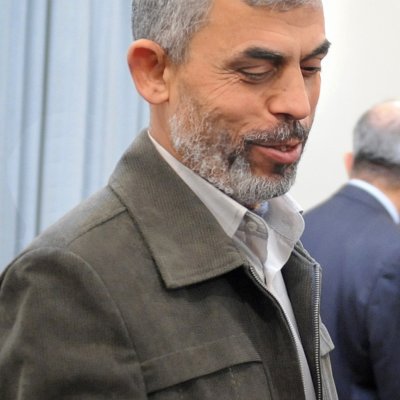
Yahya al-Sinwar
يحيى السنوار
Yahya Ibrahim al-Sinwar was born on 19 October 1962 in the Khan Yunis Palestinian refugee camp in the southern Gaza Strip. His family had been expelled to Gaza from the city of Majdal Asqalan in southern Palestine, which was occupied by Israeli forces in 1948. He had a brother named Muhammad. Sinwar was married to Samar Muhammad Abu Zamar, and the couple had three children: two sons, Ibrahim and Abdallah, and a daughter, Rida.
Sinwar attended elementary school inside the camp. He graduated from the Khan Yunis Boys’ Secondary School, after which he enrolled at the Islamic University of Gaza in Gaza City and earned a bachelor’s degree in Arabic. At the university, he was introduced to Ismail Haniyeh and Khalil al-Hayya, who later on played prominent roles in the leadership of Hamas.
Sinwar was active in the Islamic University’s student council for five years (1982–1987), serving as secretary of the arts committee, secretary of the sports committee, council vice-president, and finally as the president of the council. At the university, he headed the Islamic Bloc, the student wing of the Muslim Brotherhood. He became one of their most prominent ideologues and distinguished himself in debates with the various student groups. At the university, he founded an Islamic performing arts troupe called al-A’idoun (The Returnees).
Sinwar’s first arrested was in 1982, for taking part in the struggle against the Israeli occupation. He spent six months in al-Far‘a prison in the West Bank. In 1983, he helped to establish the brotherhood’s first security unit, called Amn al-Daʿwa (Security of the Islamic Predication) which was headed by Sheikh Ahmad Yassin, the founder of the brotherhood’s branch in the Gaza Strip. Then, in 1986, he was tasked by the brotherhood’s leadership to establish another security unit called the Jihad and Predication Organization (Munazzamat al-Jihad wa-l-Daʿwa, or Majd for short), whose main task was tracking down and punishing those Palestinians who collaborated with the occupation authorities.
Sinwar was rearrested by the Israeli occupation authorities in 1988, shortly after the outbreak of the Palestinian Intifada and the establishment of the Hamas movement. A military court sentenced him to four life terms on charges of establishing the movement’s first military organization, the Palestinian Mujahideen, and carrying out some of its operations. Sinwar spent twenty-three consecutive years in various Israeli prisons, of which a total of around four years were spent in solitary confinement. He attempted to escape from prison twice, the first while imprisoned in Ashkelon Prison and the second while in Ramla Prison. Both attempts were unsuccessful.
While in prison, Sinwar served several stints as the head of the Higher Leadership Council for Hamas prisoners in Israeli jails. He also participated in leading many hunger strikes and protest movements organized by Palestinian prisoners for better living conditions in jail.
During his long years of imprisonment, he studiously applied himself to learning Hebrew and became proficient in it. He also engaged himself in writing as well as translating numerous political and literary works.
Sinwar suffered from health problems while in prison, including persistent headaches and high fevers. Following significant pressure exerted from his fellow prisoners on the prison administration, medical tests were conducted that revealed a blood clot in his brain, and he underwent an operation that lasted seven hours. He was denied family visits throughout his imprisonment. Upon his release, his brother said that the Israeli authorities had prevented him from visiting Yahya for eighteen years and that his father had been able to visit him just twice in thirteen years.
On 11 October 2011, Sinwar was released by the Israeli occupation authorities as part of a prisoner exchange deal made with Hamas. The deal, called Wafaa al-Ahrar (“The free keep their word”), stipulated the release of 1,027 Palestinian prisoners in exchange for the release of Israeli soldier Gilad Shalit, who was being held captive by the movement in the Gaza Strip. Sinwar reportedly played a significant role in negotiating the terms of the deal, which prompted the Israeli Prison Service to place him in solitary confinement before it was concluded.
In 2012, Sinwar (by now known as Abu Ibrahim) was elected as a member of the leadership of Hamas in the Gaza Strip and became responsible for the security portfolio. Then, in 2013, he was elected as a member of Hamas’s political bureau and given charge of its military affairs.
During Israel’s war on Gaza in 2014, his house was bombed and destroyed by the occupation’s air force. In 2015, the American authorities added him to their list of “specially designated global terrorists.”
In February 2017, Sinwar was elected as head of the political bureau of Hamas within the Gaza Strip, succeeding Ismail Haniyeh, and in March 2021, he was re-elected to this position for a second term.
Sinwar was one of the most prominent endorsers of the Great March of Return, a series of demonstrations led by the Higher National Council for the Great March of Return and Breaking the Siege. The demonstrations began near the Gaza border fence in March 2018 and went on for an entire year, during which Israel shot dead around 192 Palestinians and wounded more than 28,000. In an exclusive interview with the TV channel al-Mayadeen on 21 May 2018, Sinwar affirmed that the marches aimed to “revive the right of return… [as] one of the fundamental principles” of the Palestinian people’s struggle. He described the marches as the expression of a “national [liberation] movement that adopts popular resistance as a mode of struggle,” given that it was “the best option at this stage.” He clarified however that this did not mean “abandoning other options, including the one of armed resistance, which remains in our arsenal.” Resorting to peaceful popular resistance was not a sign of “weakness,” but rather an understanding that “perhaps we can achieve our goals at a lower cost.” In response to a question about being targeted for assassination by the Israeli authorities, he replied: “Our lives are not any more precious than the life of the youngest martyr who has sacrificed himself… We are [more] afraid to die in our beds … [yet] we do not fear being killed for the cause of our faith and our homeland.”
In early October 2018, an Italian journalist named Francesca Borri, working as a freelancer for the Italian newspaper La Repubblica, conducted a lengthy interview with Sinwar, which was considered to be his first interview with the Western media. However, it created widespread controversy when it was republished by the Israeli newspaper Yediot Ahronot. This prompted Sinwar’s office to clarify in writing: “the foreign journalist had submitted a formal request to meet with the [Hamas] movement's leader in Gaza on behalf of two newspapers, Italian and British, and the interview was conducted on that basis,” and that “prior inquiries about her showed that she is not Israeli and has never worked before with the Israeli press.”
That interview was published by AljazeeraNet on 4 Ocober. Asked about why he continues to fight, Sinwar responded: “I want an end to the siege and freedom for my people. When I walk along the beach at sunset and see all these teenagers chatting with each other, wondering what the world looks like on the other side of the sea and what life is like there, it breaks my heart; it really should break everyone's heart. I want them to be free.” He adds: “I have engaged in struggle throughout my life for my people to win their freedom and to gain the right to live a normal life. I will not surrender; I will carry on, as do my people ... The problem is not in our resistance, the problem is in their occupation. Without occupation, we would have a normal life like the rest of humanity, and there would be no need to launch rockets, balloons, or even kites.”
When asked about the character of Hamas as a movement, he answered: “Because of Israeli propaganda, many in the West think Hamas is just an armed faction that is only concerned with military operations. But let me assure you that Hamas is much more, it is a broad social movement active in many ways when it comes to society building and attending to people’s needs. We have many activities in the field of social welfare, assisting the poor, and building schools and hospitals. We also have institutions for taking care of children. I would also like to emphasize that women are partners in all this work, among our leadership and even among our rank-and-file members. Some may be surprised to learn that women make up half of Hamas’s party base. We the leadership of the organization instruct our cadre that alongside resisting the occupation, it is their duty to contribute to building up their society and to serve their people.”
In May 2021, Sinwar played a prominent role in Operation Sword of Jerusalem, which erupted following Palestinian mass mobilization during what became known as the Unity Intifada. On 10 May, Hamas issued an ultimatum to the Israeli authorities from the Gaza Strip, demanding they withdraw police and settlers from around the al-Aqsa Mosque and stop their suppression of Muslim worshippers by 6 pm. When the deadline passed, Hamas launched a barrage of rockets directed at the outskirts of Jerusalem, which triggered an eleven-day confrontation that spread to all of historic Palestine. This included a large-scale offensive launched by the Israeli occupation forces against the Gaza Strip, which resulted in the deaths of 232 Palestinian civilians and the wounding of approximately 1,900. During this offensive, Israeli warplanes bombed and destroyed Sinwar’s home once again.
The Israeli government accused Sinwar of masterminding the al-Aqsa Flood operation that took place on 7 October 2023 and placed him at the top of its list of those targeted for assassination. The Israeli security apparatus continued to search for him for an entire year during the war (dubbed Iron Swords) that Israel launched on the Gaza Strip. At times the Israelis claimed that he was hiding in the tunnels beneath Gaza while surrounded by several Israeli detainees as human shields, while on other occasions they said that he had managed to escape out of Gaza through the tunnels and was hiding in the Sinai desert.
Sinwar never appeared in public throughout the months of the war. The Israeli newspaper Haaretz reported that he met with some of the Israeli detainees held by Hamas and told them in fluent Hebrew that they were in the safest place and that no harm would come to them.
On 20 May 2024, Karim Khan, the Prosecutor of the International Criminal Court, announced that he had applied to the Court for arrest warrants to be issued against Israeli Prime Minister Benjamin Netanyahu and his Defense Minister Yoav Gallant, as well as against Hamas leaders Yahya Sinwar, Mohammad Deif, and Ismail Haniyeh, all on charges of war crimes. Commenting on this decision, senior Hamas official Sami Abu Zuhri said, “The request to issue arrest warrants against three of the movement’s leaders is to equate the victim to the perpetrator, and thereby encourages Israel to continue its genocidal war in Gaza.”
On 6 August 2024, Sinwar was elected as chairman of the political bureau of Hamas and “overall leader” of the movement, as successor to the previous leader Ismail Haniyeh, who was assassinated by Israel in the Iranian capital Tehran, on 31 July 2024.
On 17 October 2024, the Israeli army and the Shin Bet (the internal security and counterintelligence service, a.k.a. the Shabak) issued a joint statement announcing the killing of three people in a military operation carried out by the army in the Gaza Strip. The statement said that “the army and the Shin Bet [were] investigating the possibility that Sinwar was killed in the operation.” Israeli authorities later confirmed his death after conducting DNA tests, using samples they had of Sinwar from when he was a prisoner to match him. They also said the autopsy showed he had not eaten in three days. In fact, Sinwar was killed during combat with a unit of the Israeli occupation army in Tall al-Sultan in the Rafah governorate. The following day, senior Hamas official Khalil al-Hayya announced the martyrdom of Sinwar in a televised address, which was broadcast by al-Jazeera. His death in combat with occupation soldiers resonated deeply among the Palestinian people, bringing him wide sympathy.
Sinwar was described as a circumspect person who did not speak much and rarely appeared in public. He was reportedly a highly skilled leader and exerted a strong influence on members of Hamas. He was also known for wanting unity amongst Palestinian factions and for his tireless efforts to achieve Palestinian reconciliation by repairing the rift between Hamas and Fatah. In prison, Sinwar had participated in drafting the text of the Palestinian Prisoners’ National Conciliation Document in May 2006, along with two other senior imprisoned Palestinian leaders: Marwan Barghouti, member of Fatah’s Central Committee, and Ahmad Sa‘adat, General Secretary of the Popular Front for the Liberation of Palestine. Known as the Prisoners’ Document, this is considered one of the most important documents upon which internal Palestinian dialogues aimed at achieving national unity were based.
Writings and Translations
Yahya Sinwar wrote a number of books in the fields of politics, security, and literature, including a book an account of the Majd (Jihad and Predication Organization), published in 2010, a book about the Hamas movement titled al-Tajriba wa-l-khataʾ (Trial and Error), and a two-part novel titled al-Shawk wa-l-qurunful (Thorns and Carnations), published in 2004. In this novel, he depicted the experience of the Palestinian liberation struggle after 1967. In its preface, he writes: “This is not my own personal story, nor is it the story of any specific person, even though all the events it depicts are real; each event, or each set of events in it, have to do with this or that [actual] Palestinian person …The fictionalizing that has been done has only been to make it into a narrative centered around particular characters in order to fulfill the criteria for it to be read in the form of a novel. Everything else is real and things I personally experienced. I also heard much of it directly from those who lived through it - either they themselves or their families and their neighbors - over several decades on the soil of our beloved Palestine.”
He also translated from Hebrew a book about Israeli political parties and two autobiographies of former chiefs of the Shin Bet: Yaakov Peri’s The One Coming to Kill You, and Carmi Gillon’s The Shabak and Its Internal Divisions.
Sources
Caridi, Paola. “Israele afferma di aver ucciso Yahya Sinwar. La sua biografia,” “Invisible Arabs” (blog), 21 ottobre 2024.
“Yahya Sinwar, le chef du Hamas qui a étudié la psyché d’Israël pour exploiter ses faiblesses,” Courrier international, 4 juillet 2024.
الجزيرة نت، "يحيى السنوار أسير محرر قاد حركة حماس واستشهد في مواجهة مع الاحتلال"، آخر تحديث في 18 تشرين الأول/ أكتوبر 2024.
https://www.aljazeera.net/encyclopedia/2017/2/13/تعرف-على-يحيى-السنوار-قائد-حماس-الجديد
"الجزيرة نت تنشر مقابلة تزعم صحيفة إسرائيلية إجراءها مع زعيم حماس بغزة"، 4/10/2024.
https://www.aljazeera.net/news/2018/10/4/الجزيرة-نت-تنشر-مقابلة-تزعم-صحيفة
الجزيرة نت، "إعلام إسرائيلي: السنوار ترجم كتابين لرئيسين سابقين للشاباك"
https://www.aljazeera.net/politics/2024/2/5/إعلام-إسرائيلي-السنوار-ترجم-كتابين
حركة المقاومة الإسلامية-حماس، "السيرة الذاتية لرئيس المكتب السياسي القائد المجاهد يحيى السنوار (أبو إيراهيم)".
https://almoqawma.com/2024/08/07/3245/
قناة الميادين، "حوار خاص مع يحيى السنوار رئيس حركة حماس في غزة"، 21 /5/ 2018.