
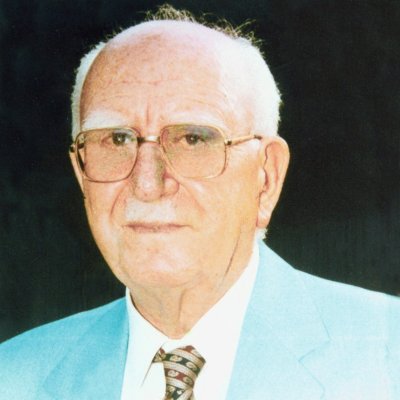
Constantine Zurayk
قسطنطين زريق
Constantine Zurayk was born on 18 April 1909 in Damascus into a middle-class Greek Orthodox Christian family that resided in Hayy al-Qaymariyya, a well-known neighborhood in the old city of Damascus. The family was known as a mercantile family, and al-Qaymariyya was famous as the birthplace of some of the most prominent businessmen of Damascus.
His father, Kaysar Zurayk, had emigrated to Colombia but then returned to Damascus before World War I and married Afifa Khoury. They had four children; Constantine was the eldest. Kaysar Zurayk then emigrated once again to Colombia in 1923, where he died just a year later.
Constantine Zurayk married Najla Cortas, and they had four daughters: Ilham, Huda, Afaf, and Hanan.
Upbringing and Education
Zurayk spent his childhood and early youth in Damascus. His family had relocated to a residence that was in the vicinity of the Orthodox cathedral and had Orthodox schools, while still being adjacent to the city’s Muslim-majority neighborhoods. The atmosphere of tolerance and living and working side by side that prevailed between the two religious communities left a profound impact on Zurayk’s psyche and his personality.
Zurayk completed his primary and secondary school education at the Greek Orthodox School of Damascus (al-Assiyeh). Despite the school’s confessional affiliation, it included a fair number of Muslims in its student population. It was also known for its high academic standards, particularly in Arabic language and related subjects. Due to his outstanding academic performance, Zurayk received a scholarship to study mathematics at the American University of Beirut (AUB) in 1924, at the age of 15, although he subsequently changed his field of study to history, earning his bachelor’s degree from that institution in 1928.
After graduating from the university, Zurayk traveled to the United States and earned a master’s degree in history in 1929 from the University of Chicago and a doctoral degree in 1930 from Princeton University.
Professional Career
After obtaining his doctorate, Zurayk returned to Beirut, where he was appointed assistant professor at AUB. In 1942, the university promoted him to associate professor.
After the end of World War II, Zurayk worked with the Syrian diplomatic service in 1946 and 1947. He served as First Counselor at the Syrian Legation and as Minister Plenipotentiary of the Syrian Republic in Washington, DC and as an alternate delegate for Syria in the UN Security Council in New York.
Zurayk returned to Beirut and resumed his position as professor at AUB. From 1947 to 1949 he also served as vice-president of the university.
In 1949, Zurayk was appointed Rector of the Syrian University in Damascus, a position he held until 1952. During that year, Colonel Adib al-Shishakli was in power, and units of the Syrian military police entered the university campus to suppress a student demonstration that had been organized there. When Zurayk went down to the university plaza to protect the students, he was assaulted by one of the military police officers; the Syrian government formally apologized to him but he resigned. He then returned to AUB to serve as Vice-President and Dean of Faculties from 1952 to 1954, and then as the university’s Acting President from 1954 to 1957.
From 1957 to 1977, Zurayk served as Distinguished Professor of history at AUB. In 1965, he traveled to the United States, where he was Visiting Professor at Columbia University. In 1967, he was awarded an honorary doctorate in literature by the University of Michigan, and in 1977 he was a visiting professor again, this time at Georgetown University and then the University of Utah. After he retired in 1977, Zurayk continued teaching at AUB and supervising master’s and doctoral theses in his capacity as Distinguished Professor Emeritus until his death in 2000.
Arab Nationalist Activity
As an AUB professor, Zurayk came to prominence as the mentor and spiritual father of a literary-intellectual student society with Arab nationalist leanings. The group, al-Urwa al-wuthqa (the unshakeable bond) was founded after World War I and published a magazine with the same name to which some of the university's Arab professors and students contributed.
In 1935, Zurayk became directly involved in political activity. He helped establish the initial core group of the pan-Arabist al-Haraka al-arabiya al-sirriya (The Secret Arab Movement) in Beirut, which he then headed. This movement, whose activities extended across several Arab countries, came to be known as the “Red Book Group,” due to its charter, called “Arab Nationalism,” which was published with a red cover. Zurayk spoke of the movement: “We were of the opinion that we would establish a nationalist movement comprising a select group of thinkers and activists whose primary concern would not be to jump onto the bandwagon of political maneuvering of the time, but rather to lay the foundations for a comprehensive nationalist organization based on a correct understanding of Arab national goals.”
Another founding member, Taqi al-Din al-Sulh, said that “there was no particular significance behind the name ‘Red Book’; it arose by pure coincidence because the cover of the organization’s charter happened to be imprinted on red paper, and they named it ‘The Red Book’ from its appearance.” The content of the charter called for working toward the establishment of “a civilized Arab nation-state, capable of preserving the existence of the Arab people both materially and spiritually, elevating their status so that they may continue to fulfill their mission and bring their message to humanity and civilization the world over.” The charter emphasized that the pursuit of “an Arab nation-state [was] not one based on religion, with religion to have no role in purely secular affairs such as administration, governance, and civil and penal law.” The charter further stressed upon the necessity for the common Arab citizen to understand better the true nature of his national cultural identity as an Arab, so that he “may know the truth about himself as an individual, hold up proudly the qualities and virtues he has, and exert his utmost to rectify the flaws widespread among the Arabs, such as individualism that hinders cooperation, a lack of self-confidence, and an excessive preoccupation with spiritual matters.”
This movement started schools, organized literacy campaigns, and trained youth in using weapons. It sent weapons to Palestinian revolutionaries during the Great Palestinian Revolt (1936–39) against the British, and was involved in the revolutionary movement in Iraq in May 1941. The movement, led by Rashid Ali al-Kilani and the four Iraqi army colonels known as the “Golden Square,” aimed to expel the British from Iraq and overthrow the monarchy to establish a republic.
Zurayk became disillusioned after this revolutionary movement failed to achieve its goals. He withdrew from direct political activity and focused his attention instead on intellectual pursuits. Nevertheless, he would exert a clear influence on the individuals who were part of the core group of pan-Arabists from which the Arab Nationalist Movement emerged.
A Critical Approach
Constantine Zurayk occupies an illustrious position among contemporary twentieth-century Arab intellectuals. He was one of the pioneers of Arab nationalist thought and an advocate of an Arab cultural renaissance grounded in freedom, democracy, secularism, and science. He took special interest in the study of the history of the Arabs, regarding it as a tool with which to think about the Arabs’ future.
In 1939, Zurayk published his first book, National Consciousness: Perspectives on Nationalist Life Flowering in the Arab East. In it, he argued: “there is no hope for an Arab national renaissance unless it is drawn from a nationalist philosophy that can envision its own spirit, can specify the direction it will be headed in, sets its goals for itself, and determines the ways and means to reach them.” He also saw the need to transform this philosophy into a national doctrine that “pushes Arabs, in both the individual and collective sense, to move forward toward the correct goals, filling their minds with resolve and hope, while also instilling in them a sense of meaning, one that they are sublime and beautiful.”
Then, in August 1948, Zurayk published his next book Maʿna al-Nakba (The Meaning of the Disaster). This book was perhaps the first to posit the term nakba to describe what had happened in Palestine. In it, Zurayk sought to analyze both the immediate and underlying causes of the defeat through the lens of internal examination and to explore ways to overcome the weakness that characterized the life of the Arabs. Zurayk was in fact the first to adopt the methodology of self-criticism in his approach to the Nakba—a methodology that remained central to all his later works. He pointed out that the victory the Zionists achieved “lies not in the superiority of one people over another, but to the superiority of one system over another. The reason for their victory is that the roots of Zionism are deeply embedded in modern Western life, while we [the Arabs] for the most part remain distant from this life and hostile to it. While they live in the present and for the future, we continue to dream of the past and stupefy ourselves with its fading glory.”
In 1953, Zurayk further emphasized the necessity of heightening the awareness of the danger posed by Zionism, which he considered the greatest existential threat to the Arabs. He argued that the extent to which we can sense this danger is directly linked to the extent of our knowledge about it: “our ignorance of Zionism and its plans is scandalous and disgraceful.” While the Zionists “know everything about us down to the smallest detail and thus have a correct assessment of our points of strength and weakness,” we, on the other hand, are “utterly ignorant of their present reality and their designs for the future.”
In his book Whither the Morrow? published in 1957, Zurayk showed that he understood the role of external factors and the strength of the Arabs’ enemy. However, he again delved deeper into the Arabs’ own responsibility for their sorry state and their confused fumbling and stumbling. He wrote: “As I study the past history of our Arab nation, I have often wondered about the reasons for the decline of its power and the decay of its civilization. Previously, I used to attribute it to the wars it had to go through and the invasions it was hit by. Now, however, I have come to believe beyond a doubt that the primary and most significant cause of all this was internal weakness, resulting from the weakness in the principal premise for both order and creativity to exist—namely, the Arab personality.” Elsewhere he said: “The Arab mind has closed off the doors and windows open to it, and has therefore cut itself off from the chance to grow; and everything that does not grow decays, just as everything that does not move forward falls behind. The Arab spirit has become preoccupied by personal interests and material pleasures, and the effort it exerts has diminished, which has weakened its moral fiber, and its appreciation of the responsibility it bears has dulled. It is therefore no wonder that it has ceased to be what it once was and the Arabs have lost their very sense of themselves as an entity; they once acted with agency, but have now become reactive.”
In 1965, Zurayk further expanded upon these ideas and explicitly called for the establishment of a science with which to study the Nakba. In an article published that year in the Damascene journal al-Maʿrifa, he observed: “We often hear and read about ‘Nakba literature.’ We may wonder whether this literature is worthy of the calamity that befell the Arabs in Palestine and has the capacity to be a catalyst for new forces that will wipe out all traces of this calamity, embarking towards our triumph over it.” Yet he thinks that there is a question “no less, if not more, serious than this one that is imperative to ask, especially in our day and age; viz. about producing accurate and comprehensive studies of the Palestinian issue: its origins, its phases, its present condition, and its future. We mean here to aspire for what we may, or rather, what we must call: Nakba-ology, a science of the Nakba.” He believed that despite the abundance of people speaking out with pronouncements on the Palestinian issue, one type of voice remained conspicuously absent: “the scientific voice, one that is capable of addressing this issue—just as it would address any other— a comprehensive perspective through systematic study, continuous monitoring and meticulous research.” The Palestinian issue, he noted, “is no simple, straightforward matter; it has historical, legal, political, economic, scientific, and other dimensions, and each of these requires analysis by a specialist.”
In response to those who might find this statement strange, given that the Palestinian cause is not a scientific question but rather one of rights—"the natural and legitimate right of the Arabs to their country and their land”—Zurayk emphasized that merely having a legitimate right is insufficient unless it is “supported by force or backed by power.” One type of power is “the power of the intellect, which gains mastery over its object of study through perseverance and constant examination that gives it an all-encompassing knowledge of it, and creates within and around it a scientific, artistic, and intellectual arsenal that can become a powerful support to bolster prudent and effective action … particularly given that the Zionist enemy “since its inception, instead of neglecting this power, has made it one of the most firmly established foundations to buttress its work.”
Zurayk’s call for the establishment of a “Nakba science” stemmed from his firm conviction—one that remained steadfast throughout his entire life—about the importance of a state founded on reason, as well as from his belief in the crucial role of the committed Arab intellectual in spreading awareness and illuminating the path to be taken by the struggle. To him, intellectuals were “those who comprehend problems, set goals, draw up plans, and specify duties and tasks.” One of the intellectual’s primary duties in times of crisis is “to feel the crisis, to experience it as his own.” Under the pressure of living through the crisis, the intellectual must come to an understanding of his role, which can be formulated as “discerning what is right and embracing it, confronting ignorance and combating it, and rising up against injustice and corruption.” However, if an intellectual adopts the model of a businessman as the ideal to follow and intends to work for the sake of material gain, then he has “lost sight of his purpose and neglected his duty.”
Following the defeat of June 1967, Zurayk published The Meaning of the Nakba Anew, in which he followed the same approach as his earlier book to analyze the causes, evaluate the consequences, and deduce the lessons to be learned. He reckoned that it was primarily civilizational differences that set the Israelis apart from the Arabs: “Our Arab society and the Israeli society that we are confronting belong to two different civilizations, or are in two varying stages of civilization.” This, he argued, “is the essential reason for our weakness despite our being greater in number, and for them being stronger despite their being fewer in number.” This civilizational difference between the two societies was also manifested “in their wholehearted adoption of the principles of modern civilization, particularly in the fields of science and rationalism that are the distinguishing markers of this civilization.”
Zurayk maintained that there were two interconnected ways for overcoming the effects of the Nakba: “civilizational renewal” and nation-building. Civilizational renewal meant “to become, in both action and spirit—and not merely in name and physical form—a part of the world we live in; to speak its language, to keep pace with it in ways of life and thought, to gain knowledge of its fundamental principles, and to integrate our capacities with all of its capabilities.” In his view, this goal could not be achieved “unless a fundamental transformation takes place in the state of the Arab world, and a total revolution in our modes of thinking, working, and our lives as a whole.” At the societal level, civilizational renewal required the establishment of scientific, progressive societies. If the degree to which a society could be said to have imbibed the scientific method was the primary yardstick on which to measure progress, there was, in his view, another even broader, more critical criterion of measurement: that of morality and ethics. This was visible in several ways, including how much political, social, and intellectual freedom there was; combating social ties that stood in the way of the bond of national unity; the realization of a secular state through the absolute separation of the state from organized religion; respect for an independent judiciary; the guarantee of economic and social justice and equal opportunities for people; acknowledgment that every individual citizen has a unique personality whose human dignity is sacrosanct; and keeping an open mind to imbibing the best intellectual and spiritual values that human civilizations have arrived at and whose soundness has been validated by human experience.
The second path Zurayk identified for the Arabs to overcome the catastrophes that had befallen them was nation-building, embodied in the establishment of a unified, progressive national entity, so that “the Arabs are organized into a united federation that integrates their foreign policy, economic policies and their defense forces.” Such a union, he argued, could not be achieved by the Arabs without the fulfillment of a fundamental condition: “economic, social, and intellectual evolution.” Nations did not materialize into existence in the West, nor would they do so in any other part of the world, “unless certain economic, social, and intellectual conditions were fulfilled.” A nation could only arise “from the ruins of feudalism—not to speak of tribalism—sectarianism, fatalism, and belief in the supernatural; it could only be founded when machine technology came in and transformed stagnant, fragmented and primitive economic systems and modes of living into a set of advanced, specialized, and interconnected systems, when the formidable barriers of class that existed among the people were taken down, and organized, logic-based science was disseminated, thus regulating the impulses of the imagination and the flow of ideas, and transforming a simplistic, naive mindset into a complex, conscious and open-minded one.” As for those currently at work [at the time of writing] to establish a united, pan-Arab national entity on the basis of the existing social order in Arab societies, “they strive in vain, because their efforts do not align with the course of history of societies and the laws governing it. These efforts will not bear fruit unless the struggle waged for unity is tied hand-in-hand to a struggle for internal revolution within and is built upon such a foundation.”
Zurayk remained firmly convinced that the final triumph in the Arabs’ battle with Zionism and the forces behind it would not be achieved unless such a radical revolutionary transformation occurred in the life of the Arabs. In an article titled “al-Mahatta wa-l-tariq” (“Stops on the Road”) published in the London-based newspaper al-Hayat on 1 November 1991, he summed up his views on civilizational renewal and nation-building: “Our destiny is ultimately linked to how much nation-building and civilizational renewal we can carry out. Our past defeats resulted from how meager our gains have been in these two complementary arenas. Zionism would not have become the grave danger it is today had we readied ourselves by building up the capacity required for our struggle against it. The conflict between us and it is not one between religions, ethnicities or creeds; rather, it is a conflict between a stagnant, fragmented front oblivious to its own sorry state and a vibrant, resurgent front that has mobilized every source of strength in its society and harnessed every center of influence it has around the world for its purposes.”
He elaborated: “We will only triumph over the ambitions of Zionism and the hegemonic global powers to the extent that we make gains in our internal arenas of struggle: in reforming the systems of government, implementing the rule of law and order, and achieving economic and social development. This must be achieved in each and every one of our Arab countries and in our society across the Arab nation as a whole, namely that to the extent our struggle is a joint pan-Arab struggle, it is at once a struggle directed within, one that has nation-building and civilizational renewal as its twin goals.”
Membership in Scholarly Associations
Zurayk was elected a corresponding member of the Arabic Language Academy in Damascus from 1954 until 2000. He was also a supporting member of the Iraqi Academy of Sciences from 1979 to 2000, and an honorary member of the American Historical Association.
He was appointed as a member of the UNESCO Executive Board from 1950 to 1954, and as a member of the organization’s International Commission for a Scientific and Cultural History of Mankind (subsequently called the History of Mankind Project) until 1969. He was also nominated as a member of the Administrative Board of the International Association of Universities (IAU), from 1955 to 1965; as association president from 1965 to 1970; as its president emeritus from 1970 to 2000; and as president of Friends of the Book Society in Beirut from 1960 to 1965.
Institution Building
In 1962, Zurayk, Walid Khalidi and Burhan Dajani conceived of starting a research institution dedicated to the Palestine question and the Arab-Israeli conflict. In 1963, the Institute for Palestine Studies was founded in Beirut, with Zurayk holding the position of chairman of its board of trustees from its inception until 1984. He was then appointed as honorary chairman of the board until his death in 2000.
In 1975, Zurayk was also among a select group of Arab intellectuals who together founded the Center for Arab Unity Studies in Beirut. The center was created as an intellectual and scholarly project whose area of specialization would be in issues of Arab unity.
Prizes and Medals
Zurayk was awarded the Syrian Order of Merit-First Class by the Syrian Republic in 1952 and the Syrian Order of Merit-Distinguished Class in 1954. In 1956, he was awarded the National Order of the Cedar with the rank of Commander by the Lebanese Republic and then the same medal with the rank of Grand Officer in 1999, as well as the Order of Public Instruction. The Hashemite Kingdom of Jordan awarded him its Order of Independence-First Class in 1994. He also received the title of Honorary Citizen by the city of Cartagena, Colombia in 1967. Other awards he received include the Arab Historian’s Medal from the Union of Arab Historians in 1993; the Order of Saints Peter and Paul with the rank of Commander from the Greek Orthodox Patriarchate of Antioch and All the East in Damascus in 1993; the Arab Cultural Merit lifetime recognition award from the Arab League’s Educational, Cultural and Scientific Organization in 1999.
Death
Constantine Zurayk died at the AUB Medical Center on 12 August 2000 at the age of 91.
In a statement, the university described him as “a colossus of his time, yet one who was characterized by his humble and kind personality, and treated everyone, from students to heads of state, with the same politeness and respect.” The university now holds a collection of Zurayk's personal papers, donated by his daughters in November 2011, which include his personal and professional writings, lectures, and correspondences. The Municipality of Beirut renamed a street after him in the Hamra district, located close to the university where he spent most of his life.
In 1984, the library of the Institute for Palestine Studies in Beirut was named after Zurayk following a decision taken by the Institute’s Board of Trustees in tribute and appreciation for his scholarship and service. The institute had also published a festschrift in 1988 to honor him.
In February 2002, some of Zurayk’s acquaintances and relatives founded and established the Constantine Zurayk Cultural Foundation in Beirut. The foundation’s objectives include providing assistance to researchers, scholars, and graduate students to conduct research and scholarly studies; engage in cultural activities; host scientific and scholarly conferences and forums; and award prizes to scholars.
Al-Jazeera’s documentary channel, al-Jazeera Wathaʾiqi, produced a film about Zurayk’s life, ideas, and the struggles he was a part of, called “The Sheikh of Historians, Constantine Zurayk,” which was broadcast on the network in 2021. Zurayk had in fact begun writing his autobiography but died before he could finish it. Whatever he did manage to complete was published in a volume edited by Hisham Nashabeh, his colleague and friend at Institute for Palestine Studies under the title Memories: the Unfinished Autobiography of Constantine Zurayk, published in 2017 by Center for Arab Unity Studies.
Selected Writings
Constantine Zurayk authored dozens of books, scholarly studies, and articles; some of the more well-known titles are listed here:
"الوعي القومي: نظرات في الحياة القومية المتفتحة في الشرق العربي"
[National Consciousness: Perspectives on Nationalist Life Flowering in the Arab East, 1939]
"معنى النكبة"
The Meaning of the Disaster. Translated by R. Bayly Winder. Beirut: Khayat's, 1956.
"أي غد؟ دراسات لبعض بواعث نهضتنا المرجوّة"
[Whither the Morrow? Studies on Some of the Factors Driving Our Desired Renaissance, 1957]
"نحن والتاريخ: مطالب وتساؤلات في صناعة التاريخ وصنع التاريخ"
[History and Us: Demands and Questions About the Manufacturing and Moulding of History, 1959]
"هذا العصر المتفجر: نظرات في واقعنا وواقع الانسانية"
[This Explosive Era: Perspectives on Our Reality and that of the Human Race, 1963]
"في معركة الحضارة: دراسة في ماهية الحضارة وأحوالها وفي الواقع الحضاري"
[On the Battle of Civilizations: A Study of the Essence of Civilization, Its State, and on Civilizational Reality, 1964]
"أعظم من منتصرين"
[Greater than Just Victors, 1966]
"معنى النكبة مجدداً"
[The Meaning of the Nakba Anew, 1967]
"نحن والمستقبل"
[The Future and Us, 1977]
"مطالب المستقبل العربي"
[What the Future Demands of the Arabs, 1983]
"ما العمل؟ حديث إلى الأجيال العربية الطالعة"
[What Is to Be Done? A Message to the Younger Generation of Arabs, 1998]
In 1994, the Center for Arab Unity Studies in Beirut published a collection of his complete intellectual works in four volumes with a preface by Zurayk himself.
Sources
Archives and Special Collections Department, American University of Beirut. “Constantine Zurayk Collection, 1909-2016.”
https://www.aub.edu.lb/Libraries/asc/Collections/Documents/FindingAids/C...
Nashabé, Hisham, ed. Studia Palaestina: Studies in Honour of Constantine K. Zurayk. Beirut: Institute for Palestine Studies, 1988.
Zurayk, Constantin. “Un Arabe dans le siècle: Fragments d’une autobiographie.” Revue d’études palestiniennes, no. 63 (printemps 1997) : 108-118.
الحساني، أحمد. "المؤرخ السوري قسطنطين زريق معماري الفكر القومي العربي في القرن العشرين"، "الجزيرة نت"، 28 حزيران/يونيو 2021.
https://www.aljazeera.net/culture/2021/6/28/المؤرخ-السوري-قسطنطين-زريق-معماري
سويد، محمود. "العروبة وفلسطين: حوار شامل مع قسطنطين زريق". بيروت: مؤسسة الدراسات الفلسطينية، 2003.
الشريف، ماهر. "النكبة ومعناها في مرآة العقل النقدي". "مجلة الدراسات الفلسطينية"، العدد 74-75، ربيع-صيف 2008.
صايغ، أنيس (محرر). "قسطنطين زريق 65 عاماً من العطاء". بيروت: مكتبة بيسان للنشر والتوزيع والإعلام، 1996.
العظمة، عزيز. "قسطنطين زريق عربي للقرن العشرين". بيروت: مؤسسة الدراسات الفلسطينية، 2003.
علي، محمود محمد. "قسطنطين زريق رائد الفكر القومي العربي وعملاق المؤرخين العرب". "صحيفة المثقف"، 13 أيار/مايو 2022.
https://www.almothaqaf.com/memoir02/962920-قسطنطين-زريق-رائد-الفكر-القومي-العربي-وعملاق-المؤرخين-العرب
عماد، عبد الغني. "قسطنطين زريق الداعية والمفكر القومي العربي". بيروت: مركز دراسات الوحدة العربية، 2012.
"قسطنطين زريق". "مركز الشرق للدراسات الحضارية والاستراتيجية"، 22 حزيران/ يونيو 2002.
https://www.asharqalarabi.org.uk/center/rijal-zraiq.htm
متاريك، أحمد. "جماعة الكتاب الأحمر.. قادت العرب عشر سنوات ولا يعرف قصتها أحد"، "رصيف 22"، 21 كانون الثاني/يناير 2022.
https://raseef22.net/article/1085741-جماعة-الكتاب-الأحمر-قادت-العرب-عشر-سنوات-ولا-يعرف-قصتها-أحد
نشابة، هشام (محرر). "ذكريات.. سيرة لم تكتمل، قسطنطين زريق". بيروت: مركز دراسات الوحدة العربية، 2017.
Related Content
Popular action
Great Palestinian Rebellion, 1936-1939
A Popular Uprising Facing a Ruthless Repression