
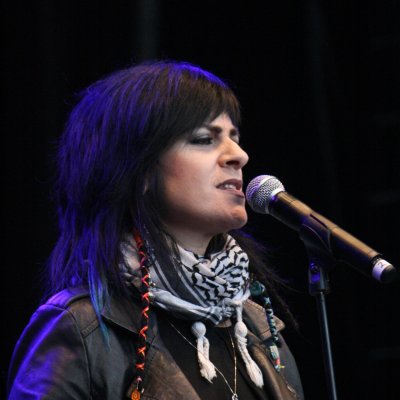
Rim Banna
ريم بنا
Rim Banna was born in Nazareth on 6 December 1966 into a Greek Orthodox Christian family. Her father was Jamil Banna and her mother is the poet Zuhaira Sabbagh. She had a brother named Firas. She was married to the Ukrainian musician, Leonid Alexeyenko, and they had three children: a daughter named Baylasan and twins named Qamran and Ursalem.
Banna attended the Nazareth Baptist School. As a child, she listened to the songs of great Arab and Palestinian musicians such as Fairouz and Ahmed Kaabour and read the novels and short stories of Ghassan Kanafani and the poems of Tawfiq Zayyad, Mahmoud Darwish, and Samih al-Qasim. All of these voices had a great influence on her artistic trajectory as a musician.
Banna loved music and singing from an early age, performing from the age of ten at school celebrations and Palestinian national festivals, such as the Land Day Festival, the Layali al-Nasira (Nazareth Soirees) Festival, and International Women's Day celebrations. Her first acting role was in the play Mais al-Reem, where she played the role originally performed by the Lebanese diva Fairouz.
In 1983, Banna acted in the play Mahatta wa Ismuha Beirut (The Next Stop Is Called Beirut) produced by theatre director Riyad Masarweh in Nazareth. The play dealt with what happened during the Israeli invasion of Lebanon in the summer of 1982 and the impact it had on the Palestinian cause.
After graduating from high school, Banna decided to pursue singing professionally. She won a scholarship from the Democratic Women's Movement to study in Moscow. In 1985, she enrolled at Moscow’s prestigious Gnesin State Academy of Music, where she studied the fundamentals of music, including modern singing and musical conducting for six years, graduating in 1991.
Banna released her first album, Jafra, in 1985 while still living in the Soviet capital. Then, in 1986, while still a student at the Gnesin academy, she released her second album Dumuʿik ya ummi (O Mother, Your Tears).
In Moscow, Banna met Leonid Alexeyenko, a Ukrainian who was a fellow student at the academy. They worked together on a number of music projects, and in 1991 they were married.
Banna then returned to Nazareth along with her husband. In 1993, she released her third album, al-Hulm (The Dream). After that, she began her project to preserve Palestine’s intangible cultural heritage and made recordings of children’s songs traditionally sung to them by their grandmothers, which had been passed down orally through the generations but were never properly archived. Her next two albums were exclusively dedicated to these songs: Qamar Abu Laylé (New Moon, 1995) and Mukaghah (Baby Gurgles, 1996).
While Banna maintained a deep commitment to the Palestinian cause, her music moved in a new direction starting with her 2001 album Wahdaha tabqa al-Quds (Jerusalem Is Left Alone), in which she was critical of the transformation of the Palestinian cause into a mere "trend" that many musicians considered fashionable to adopt. The songs on that album reiterated that the Palestinian people and their cause must not be reduced to an artistic fad. In 2005, she released the album Maraya al-ruh (Mirrors of the Soul), which was all about Palestinian and Arab prisoners in Israeli jails. The next year, she released the album Lam takun tilka hikayati (That Wasn't My Story) to coincide with Israel’s war on Lebanon in July 2006 and which she dedicated jointly to the Palestinian and Lebanese people. She then released the album Mawasim al-banafsaj (Violets in Season) in 2007, which also consisted of songs on Palestine. After that came the albums Nawwar and Bissan in 2009, which was an album of children's music dedicated to Palestinian refugee children, and Sarkha min al-Quds (A Cry from Jerusalem) in 2010, which was a joint production with other Palestinian musicians. She also took part in the operetta Bukra (Tomorrow) in 2011 with musicians from across the Arab world. Her 2013 release Tajalliyat al-wajd wa-l-thawra (Manifestations of Passion and Revolution) was suffused with mystical Sufi inclinations.
Banna's fame spread throughout Europe with her contribution to an album of lullabies called Lullabies from the Axis of Evil (2004), on which she collaborated with Norwegian jazz singer Kari Bremnes. The idea behind the album was to have female singers from countries that the [then] US President George W. Bush had labeled as being part of “the Axis of Evil." The album was essentially a rejection of U.S. policy in musical form. The album’s producer Erik Hillestad described his introduction to Banna:
With Rim, it started around Christmastime in 2002. I had asked my friend Suhail Khoury from Jerusalem if he could help me find a woman who could sing lullabies. He said there is a woman you should meet named Rim Banna. I’m sure she can sing a beautiful lullaby for you. I had never heard of her before and had no expectations, but I trusted Suhail and his sense for quality. We then drove up the hills of the Galilee in his small blue car. When I met her, she was with her baby twins. We went into a room in her house insulated from the sound of traffic outside. While her husband was looking after the twins, she sat down in a chair and I set up the recording equipment for her to perform. When she began to sing the first lullaby, Ya layl ma atwalak, it was a moment I will never forget. It really touched my heart deeply: O Night, how long you are / Barefoot you made me walk / Heavy weighs the burden I carry / It exhausted my shoulders. The recording of her singing was so strikingly beautiful. When I came home to Norway, we mixed that recording of Ya layl ma atwalak with a song by a Norwegian singer named Kari Bremnes. We reproduced the song as a duet and released it soon afterwards.
Banna continued to work with Erik Hillestad for the next five years. Their subsequent work together included producing the children’s album Nawwar and Bisan; Banna’s idea was to distribute copies of the album to children in Palestinian refugee camps both within and outside Palestine. With support from the Church of Norway, she managed to produce the album and actually handed out free CDs to children in the camps.
In 2010, Banna and her husband separated; Banna retained custody of her children.
She then put on solo concerts or participated in dozens of festivals in Palestinian cities, as well as in many festivals in cities both inside the Arab world and abroad.
Banna was diagnosed with cancer in 2009; she was treated and the disease went into remission, but then it returned. In 2016, after her vocal cords became paralyzed, she wrote a post to announce her condition: “My dears: my voice, the one you used to know, has now ceased to sing… perhaps forever.”
After she stopped singing, and in order to ensure a regular income that would enable her children to live decently, Banna began doing tatreez (traditional Palestinian embroidery)and designing and making jewelry and accessories.
Banna received several awards during her career. Most notable among them were the honorary prize of Person of the Year and Ambassador of Peace in Italy in 1994 and Person of the Year by Tunisia’s Ministry of Culture in 1997. She also won the Palestine Prize for best song of the year in 2000 and the Ibn Rushd Fund’s Prize for Free Thought in 2013.
Banna was chosen as Palestine's Cultural Personality of the Year in 2016 in recognition of her long career singing for the Palestinian cause and Palestine’s children. In her acceptance speech at the award, she spoke at the podium: "My voice has been my only weapon against the occupation, against the terrorism of Israel, which has killed, displaced, slaughtered, besieged, and sent the Palestinian people into exile, and which continues to perpetrate the most heinous of crimes against them."
A short while before her death, she wrote a touching message addressed to her children that was posted on her Facebook page: “Fear not, for this body is like a tattered shirt that will not last. When I take it off, I shall slip away between the roses laid out in the coffin and leave the funeral. Like a gazelle I shall gallop home. I will cook a delicious dinner, tidy up the house and light some candles, as I await your return on the balcony as usual. I will sit down with a cup of sage tea, and look out at the fields of Marj Ibn Amer, and say to myself: ‘This life is beautiful, and death is like a false chapter in history.’”
On 18 March 2018, Banna experienced a sudden deterioration in her health that prevented her from responding to messages and calls from her friends and fans. She was admitted to hospital in Nazareth to receive treatment. Her brother Firas wrote a post on Facebook on behalf of the family giving further information on his sister’s condition, saying that she was still clinging to hope and wished to begin planning for a new musical project and a new concert tour. The statement read: “Dear friends of Rim, her acquaintances, followers, and all her well-wishers: Rim, our beloved mother and sister, is receiving treatment in a hospital in Nazareth following a sudden decline in her health. She is fighting back against this sudden illness . . . with her usual legendary heroism that you have come to expect from her throughout the past nine years; in fact, she said yesterday that she is planning new musical projects as well as a concert tour.” The post went on to say that Rim was surrounded by family and friends who were “embracing her with love and care while monitoring her condition.” It reassured her admirers that she remained unwavering, standing firm in her love for life and for Palestine and its people, and their cause to which she had given everything in her power to fight for.
Six days after she was re-admitted to hospital in Nazareth, Banna passed away.
Her daughter Baylasan spoke of her in an interview: “I always thought of her as my mother first and not as Rim Banna, the celebrity musician. When invited to perform abroad, she never traveled without me; she always insisted that I be allowed to accompany her. I never had a babysitter to look after me, not even my grandmother. My mom was always the one raising me and looking after me, even when she had concerts. I can’t imagine anyone managing so successfully to combine being a mom and a singer at once. But that was her. It was really demanding for her, but she managed to succeed in both tasks.”
“It was really important for my mother that the children of Palestine remain connected to their musical heritage,” she added. “When she went on stage, she would explain the song she was about to sing and tell the story behind it to the non-Arabs and Arabs alike [from outside Palestine], for example in her songs about Mohammad al-Durra, Sarah Abdel-Haq, and Fares Odeh, she would tell the audience who they were [children killed by the Israeli army]. Then there was her song ‘Karmel al-Ruh’ (Mt. Carmel, my soul),’ which was written by my grandmother [Zuhaira Sabbagh], and set to music and sung by my mother, to express solidarity with the Palestinian and Arab political prisoners held by Israel.”
The Palestinian Ministry of Culture paid tribute to Banna in a statement: "The passing of Rim Banna is a great loss to Palestinian culture. She was a musician who gifted Palestine with the most beautiful of songs, songs that resonated throughout the land and that an entire generation of Palestinians has grown up listening to." The Palestinian National Liberation Movement (Fatah) also mourned her in a statement, saying that with her passing, "Palestine [had] lost a great musician who dedicated herself to raising the voice of Palestine and making the whole world listen to it. She devoted herself to the cause of her people through her lyrics and voice, affirming that art too can be a tool of the struggle for liberation."
The Lebanese musician Ahmad Kaabour said of her: “Palestine was not just an ideological or nationalist cause for Rim, but rather a universal humanist and moral cause. Her commitment to addressing people’s concerns is what brought us together. I can say with certainty that while her illness was able to take control of all the cells in her physical body, it was not able to control the cells of her willpower. She fought back against the disease, just as she fought the Israeli occupation. She was attacked because she was opposed to the Syrian regime for the sake of her commitment to the Syrian people’s humanity and had to face the culture of labeling people as traitors. They wanted to put her between the frying pan of terrorism and the fire of military dictatorship and she was caught in the crossfire, but she managed to fight to create a space of love and freedom, whether it concerned Palestine or Syria. She always took the side of all free and oppressed peoples that had suffered injustice.”
Rim Banna (whose nickname was “the voice of the cause”) described herself on her Facebook page as a Palestinian singer, musical composer, and activist for justice and freedom. Her musical style combines traditional Palestinian lullabies and other festive songs with contemporary music. She was renowned for her politically conscious and nationalist songs drawn from Palestinian heritage, and she is remembered most for her significant contribution to preserving many of these traditional songs, particularly those for children.
Banna wrote on her Facebook page that the songs and melodies she composed were taken from the collective psyche of the Palestinian people and from their heritage, history, and culture: “The music and melodies are like streams that flow out of the very heart of the poetry and the rivulets that enrich it, and from my feeling for the musicality of the words. The fusion between lyric and melody results in painfully sweet songs that lift us up to the skies over Palestine and from there to the entire world.” She described her music as “a means of expressing cultural identity”: “Part of our work consists of collecting [hitherto unwritten] texts from Palestinian heritage to save them from being lost and then set them to music. The music we try to compose for them is a contemporary music, but one inspired by traditional Palestinian music that can be a good fit for these texts. That's why I try to write songs that can suit my voice. I want to create something that is new and fresh in every possible manner, and this requires making music that draws listeners closer to the Palestinian musical spirit.”
After her death, the National Conservatory of Music established the annual Rim Banna Award for Musical Production, which aims to encourage the production of new musical and vocal works that address the Palestinian cause or global humanitarian issues, in order to influence Arab and international public opinion and draw its attention to the just cause of Palestine and issues of political and social justice around the world.
Sources
Association France Palestine Solidarité. “Rim Banna, ‘la voix de la Palestine’ s’est éteinte.” 26 March 2018.
https://www.france-palestine.org/Rim-Banna-la-voix-de-la-Palestine-s-est...
Baroud, Ramzy. “Rim Banna and the Cultural War that Palestinians Must Win.” Institute for Palestine Studies Blog, 1 May 2018.
Brehony, Louis. “Rim Banna: A Symbol of Life and Unity.” Palestine Chronicle, 25 March 2018.
https://www.palestinechronicle.com/rim-banna-symbol-life-unity/
Hamdar, Abir. “‘Voice of Resistance’: Rim Banna, Cancer, and Palestine’s Body Politic.” Medical Humanities 46, no.3 (2020): 234–42.
https://durham-repository.worktribe.com/output/1302767
Hillestad, Erik. “Laudatory Speech to Rim Banna at her Receiving of the Ibn Rushd Award 2013.”
https://ibn-rushd.org/wp/en/2013/11/15/award-2013-laudatio/
Kopti, Abir. “Je me souviens de Rim.” Middle East Eye, 25 March 2018.
https://www.middleeasteye.net/fr/opinion-fr/je-me-souviens-de-rim
بدران، وليد. "ريم بنا: رحيل فنانة فلسطينية جابت أغانيها الأرض"، "بي بي سي"، 24 آذار/ مارس 2018.
https://www.bbc.com/arabic/art-and-culture-43526973
بقبوق، عمر. "ريم بنّا: تلك حكايتها من زمن العشق الأول"، "العربي الجديد"، 24 آذار/مارس 2018.
https://www.alaraby.co.uk/ريم-بنّا-تلك-حكايتها-من-زمن-العشق-الأول
حوحو، فاطمة. "ريم بنا هربت خلسة من بين الورد المسجّى وجرت كغزالة إلى الحياة الجميلة"، 26 آذار/ مارس 2018.
https://nextlb.com/culture-arts/16603
"تدهور مفاجئ في صحة الفنانة الفلسطينية ريم البنا"، "العربي الجديد"، 19 آذار/مارس 2018.
https://www.alaraby.co.uk/تدهور-مفاجئ-في-صحة-الفنانة-الفلسطينية-ريم-البنا
الشامخ، عبد السلام. "الفنانة ريم البنا رحيل آخر كوكب في سماء فلسطين الحزينة"، "هسبريس"، 26 آذار/مارس 2018.
https://www.hespress.com/الفنانة-ريم-البنا-رحيل-آخر-كوكب-في-سما-418007.html
لوباني، حسين علي. "معجم أعلام فلسطين في العلوم والفنون والآداب". بيروت: مكتبة لبنان ناشرون، 2012.
نصر الله، سناء. "ريم بنّا.. قد تحترق عنقاء الجليل لكنها لا تموت"، الجزيرة نت"، 8 كانون الأول/ديسمبر 2025.
https://www.aljazeera.net/doc/portrait/2020/3/24/ريم-بنّا-عنقاء-الجليل-حين-تغادر-بصخب
ياغي، أمجد. "أحمد قعوار: رأيت مع ريم البنا الأمل في أطفال فلسطين"، 24 تموز/ يوليو 2018.