
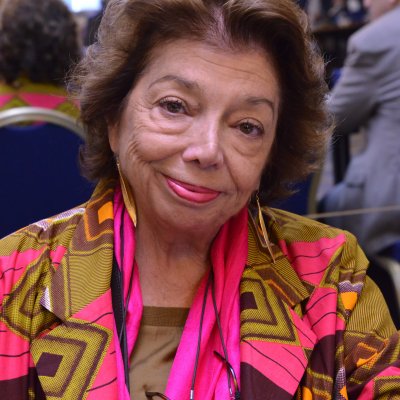
Leila Shahid
ليلى شهيد
Leila Shahid was born in Beirut on 13 July 1949. Her father, Munib Shahid, came from the city of Acre and had enrolled in the American University in Beirut (AUB) before the Nakba to study medicine and became a professor of medicine there. Her mother was Serene al-Husseini, daughter of Jamal al-Husseini, who was co-founder and chairman of the Palestine Arab Party and one of the leaders of the nationalist struggle during the British Mandate’s rule over Palestine, and whose family had been uprooted to Lebanon. Leila Shahid had two sisters, Zeina and Maya. Her husband was the Moroccan writer, Mohamed Berrada.
In an interview conducted in French on 1 April 1999, Shahid described the circumstances surrounding her birth in Beirut to a Palestinian refugee family:
My mother’s family has always been very involved in the Palestinian national movement that began at the start of the century after the fall of the Ottoman Empire and the establishment of the British Mandate over Palestine, which was supposed to pave the way for independence. The Palestinians then began to demand the right to establish a state. But it quickly became clear that, unlike Syria and Lebanon, Palestine would not get this right: it had to make way for a Jewish national home, promised by the British to the Zionists. When the Palestinian national movement realized that political and diplomatic means would not suffice to reverse the course of events, it took up arms. The first major Palestinian revolt against the British, the first intifada, broke out in 1936. My grandfather [Jamal al-Husseini] and my mother’s maternal uncle [Musa al-Alami] took part in it. [...] Meanwhile, women and children [from rebel families] were deported to countries under French mandate. That is how my mother, who was from Jerusalem, ended up in Lebanon. There she met my father, who had come from Acre, Palestine, to study. They got married. My two sisters and I were born and raised outside Palestine, as in the case for two-thirds of Palestinians.
Shahid did her entire schooling at the Collège Protestant Français in Beirut, from where she graduated with her baccalauréat diploma in 1967. She joined the Palestinian liberation movement Fatah in 1969 and began working as a volunteer in Palestinian refugee camps in Lebanon. From 1969 to 1970, she also worked with Camille Mansour, Shawqi Armali, and Fawaz Najia in editing two monthly magazines in French and English that expressed the views of the Fatah movement.
She majored in sociology and anthropology at AUB, where her studies focused on the social structure of Palestinian refugee camps in Lebanon.
In the aforementioned interview with her in 1999, she was asked how her political consciousness developed. Shahid replied:
[It was] through my family. And I was deeply affected by the 1967 war. It broke out on the day I was supposed to take my baccalauréat exams, on 5 June. The exams were canceled. We were certain we were going to win. But when, after six days, we realized that all the Arab armies—Syrian, Egyptian, Jordanian—had lost to the Israeli army alone, the shock was terrible. For Arab intellectuals, June 1967 was a real earthquake. We thought that the international community would be sensitive to the injustice and exile imposed on the Palestinians, that it would support us. On the contrary, it applauded Israel’s victory. My response was to involve myself in political activism; I also began training to use firearms. My response was to involve myself in political action. I began training to carry a weapon. It was a symbolic way of regaining my sense of dignity. But I quickly realized that I didn’t have a military vocation: I decided to do social and political work in the Palestinian camps. During my first year at university, I began a series of activities to prepare for the intifada: in 1969, the refugees rose up to obtain the right to organize politically and govern themselves. From then on, the various member organizations of the PLO were involved in the management of the camps, which were under the aegis of the United Nations through UNRWA. For me, this was a very intense period: I felt as if I had returned to Palestine, rediscovering my history and my culture.
After graduating from AUB, Shahid moved to Paris, where she continued to study and do research at the École pratique des hautes études. In 1976, she took over from Ezzedine Kalak as president of the French chapter of the General Union of Palestinian Students. Kalak, who had become the PLO’s representative in Paris, invited her to work at the organization’s mission there. She initially declined, but after he strongly insisted, she accepted and began working as an activist within the ranks of the PLO. Shahid considered Kalak to be the person who changed the course of her life, not only her political life, but her personal life as well, as he was the one who introduced her to the Moroccan writer Mohamed Berrada.
After her marriage to Berrada in 1978, Shahid spent some years with her husband in Morocco, where he taught at Mohammed V University in Rabat, and they would spend their summer vacations in France.
In 1982, Shahid played a prominent role in conveying to the outside world details of the massacre committed in the Sabra and Shatila refugee camps. She accompanied the prominent French writer Jean Genet on a visit to the site of that massacre, who subsequently wrote his famous essay “Quatre Heures à Chatila” (Four Hours in Shatila) inspired by that visit.
During the 1980s and the early 1990s, Shahid was part of the editorial board of the Revue d’études Palestiniennes, the French-language scholarly journal that was published by the Paris office of the Institute for Palestine Studies (IPS).
In 1989, Shahid was appointed by PLO Chairman Yasir Arafat as the PLO representative to Ireland, making her the first Palestinian woman to hold this position. A year later, she became the PLO’s representative to the Netherlands.
From 1993 to 2005, Shahid served as the Delegate-General for Palestine in France, during which she was active in the media and engaged in political activism that attracted the attention of French politicians and media figures. Regarding her activity during that period, she said in 1999:
I am not an ambassador like the others because Palestine is not yet a state. As the representative of a people who have been seeking recognition for 50 years, I have to fight two battles at once. The first … consists of maintaining close relations with France and the European Union to defend the political rights of the Palestinian people. The second… involves the media. It aims to reestablish certain truths. Of all the issues in international politics, the Palestinian question is undoubtedly the one that has been subject to the most widespread and persistent misinformation. Not so long ago, it was said that the Palestinian people did not exist. Palestine was presented as a land without a people—a desert—for a people without a land—the Jewish people. The name of Palestine [...] was erased from maps and history books the day Israel was created. It was an existential struggle. For decades, Israelis believed that they would disappear the day they recognized the Palestinian people. And Europeans felt that in doing so, they would be betraying the Israelis—towards whom they harbored a strong sense of guilt because of the genocide. So, it took a struggle to set the record straight and show that recognition could be mutual. Today, most Israelis, especially the New Historians, acknowledge that Palestine was not a desert in 1948.
Reducing the Palestinian people to a group of armed fighters and terrorists: this was the other major focus of disinformation. The intifada, which lasted from 1987 to 1993, played a major role in showing that this was a society like any other, with all its constituent elements, including women and children. However, not all prejudices have gone away. Palestinians are still victims of stereotypes that affect Arabs and Muslims in general; these are remnants of the colonial era and everyday racism.
In 1996, after the conclusion of the Oslo Accords, Shahid was able to set foot in Jerusalem, the birthplace of her family, for the first time, as part of a state visit by then French President Jacques Chirac.
When she worked in Paris, Shahid played a key role in promoting a number of Palestinian writers and artists to the French public, showcasing their creative work. She also forged a close friendship with the poet Mahmoud Darwish, who lived in the French capital for several years. The Lebanese novelist Elias Khoury called her the “guardian angel” who preserved Darwish’s memory and saved him from certain death in March 1998 when he visited her at her home in Paris. She discovered that something was seriously wrong with his health and insisted he be taken to hospital. There, doctors discovered that his condition was critical and immediately performed surgery on him.
In December 1999, Shahid was elected as a member of the board of trustees of IPS, and some years later, she became vice-chair of the board.
In September 2004, to commemorate the bicentennial birth anniversary of French novelist and playwright George Sand (1804–1876)—whose real name was Aurore Dupin—an event called “Elles du Monde” (Women of the World) was held in the village of Gargilesse, located in the department of Indre in central France [where Sand’s villa is located]. The event, which was devoted to discussing the status of women at the dawn of the 21st century, included Leila Shahid as its Palestinian speaker, along with seven other women from different countries across the world. Their discussions resulted in the production of a text titled L’appel de Gargilesse (The Gargilesse Appeal), in which the participants called for “equality between men and women to be made a top priority, for cross-border cooperation to work towards achieving this equality while respecting diversity among women, and for support to be given to NGOs, especially women’s organizations, that work to build a world where balance between the sexes prevails.” The appeal called on the media “to give women their rightful place, to highlight their role in our societies and to combat all sexist stereotypes,” and on educational institutions “to teach the history of women’s struggle for their rights in every country around the world, as well as their role in promoting peace, development, social justice and culture.”
When Shahid was asked in the 1999 interview about the impact of the Nakba on the status of Palestinian women, she replied:
Many Palestinian women found themselves in a foreign land, far from their traditional village environment, alongside men who were traumatized and unemployed. These men had been dispossessed of their lands and felt so deeply humiliated that they were unable to react. The women were forced to take matters into their own hands, and to organize their daily lives with very few resources. Without this uprooting, it would have taken them decades to break with tradition. Moreover, UNRWA, which was entirely responsible for education and health care in the refugee camps, both inside and outside Palestine, established a system of coeducational and compulsory schooling for all, boys and girls alike. This partly explains why Palestinians enjoy one of the highest rates of literacy in the Arab world.
That said, Palestinian women have always been cognizant that the role they played in the resistance would not be enough to secure their legal equality. They therefore sought to organize themselves, not only as nationalist activists, but also as women. There are many feminist movements, many of which are actively working on the future personal status code that will govern women’s status and are seeking to determine how to enshrine equality in the Constitution. The starting point has largely been positive, as the 1988 declaration [Declaration of Independence in Algiers] stipulates that the Palestinian state will have a parliamentary system of government ensuring equal rights for men and women. Yet the task remains difficult. We cannot isolate ourselves entirely from the rest of the region, where personal status laws are based on Islamic jurisprudence. There is ongoing debate within society between secular and religious groups and within legislative institutions. […] The struggle is far from over, neither against the occupation nor for the sake of women’s rights, and the two are intertwined.
In early 2005, Shahid published a French version of her mother Serene Husseini Shahid’s book Jerusalem Memories (published originally in English in 2000) under the title Souvenirs de Jérusalem. The memoir was translated by Mohammed Berrada into Arabic and published in 2024.
In 2006, Shahid became Delegate-General for Palestine to the European Union, Belgium, and Luxembourg, and continued to serve in this position until 2015.
In March 2009, director Michèle Collery made a documentary film about her called Leila Shahid, L’espoir en exil (released in English as Leila Shahid - Palestine Forever), jointly produced by Arte-France and Télevision Suisse Romande. In 2017, the same director also made a documentary on Jean Genet with Shahid’s participation, titled Jean Genet, un captif amoureux - Parcours d’un poète combatant (Jean Genet, A Prisoner of Love: The Wanderings of a Fighter-Poet).
In July 2012, she was chosen as a member of the board of trustees of Birzeit University.
After she resigned from her diplomatic post in 2015, Shahid focused on cultural activity. When asked by a French newspaper in early June 2022 about her reasons for resigning, she replied:
I no longer want to have anything to do with an official authority that spreads lies about a peace process that does not exist. I am one of those who believed in the Oslo process in 1993. I have lived through all the phases of the Palestinian liberation movement. There was the phase when we were merely refugees waiting for the United States to rescue us; that was an utter flop. I have lived through the rise of the Palestinian resistance, with the fidaʾis (guerilla resistance fighters) from 1967 up to 1993. I have lived through the period of negotiations for peace and two states: what a farce! Neither the Americans nor the Israelis wanted it. we were the only ones who believed in it. We were betrayed! Our situation today is much worse than it was before the Oslo negotiations.
I never viewed the role of representative of Palestine as a job, but rather as a calling. I couldn’t imagine doing anything else ... The Palestinian cause is not a nationalist cause, but a cause of rights, of justice and of decolonization, the likes of causes from Vietnam to Algeria, and South Africa. But as soon as I felt that we were deviating from this path into a somewhat “deceptive” narrative under the auspices of the European Union, Arab diplomacy and the Americans, I preferred to resign.
She commented about the role of culture in politics:
Culture is the foundation of politics; for years, we lived under the rule of ideologies…We used to think that culture had nothing to do with politics. Through experience, I realized that when it came to an issue like that of Palestinian—which, at its core, is an existential conflict and not a conflict between two equal states—culture is the expression of identity…Without culture, it is not possible to have an impact on society… Political discourse is no longer sufficient to represent the complexity of Palestinian identity; rather, we need a literary, cinematic, musical and artistic narrative.
In 2016, she took over the chairmanship of the Friends of the Arab World Institute in Paris association, focusing on giving support to Arab cultural production.
In 2022, Shahid took part in the production of the documentary Memories of Palestine, directed by the French filmmaker Serge Le Péron. She features prominently in the film, giving a remarkable testimony supported by material from her mother’s book. In an interview on France Inter radio on 9 October 2023 that also featured Eli Barnavi, former Israeli ambassador to France, Shahid described the scenes of what had occurred two days prior as “horrific,” and indicated that she “wanted to understand how such a situation could arise.” “I have a deep feeling of grief,” she added. “I was living in Paris when the Oslo Accords were signed, and I believed in them. There was back then a glimmer of hope in both societies, yet it did not last. It is very unfortunate. The war against the Palestinians has continued for 56 years in Gaza, the West Bank, East Jerusalem and the refugee camps. I am pessimistic; I believe what will happen is the annexation of the territories that have not yet been annexed. There is no longer any land left for the establishment of a Palestinian state.”
Shahid passed away at her home in La Lèque hamlet, south of France on 18 February 2026 and was buried in the Lussan cemetery. A large gathering of her French and Palestinian friends attended her funeral to pay their respects and bid her farewell. Palestinian Authority President Mahmoud Abbas issued a statement that included this tribute: “The deceased dedicated her life to defending the cause of her homeland and her people. She was a sincere voice for her country and a shining model of Palestinian diplomacy, carrying out her assigned duties with the utmost skill and capability, while contributing to bolstering the presence of the Palestinian cause on the European and international stage.”
Leila Shahid was a militant, diplomat, and intellectual who not only defended the Palestinian cause but also embodied it. She was the voice of Palestine and the Palestinian people in Europe. Most of the European media knew her as a champion of the Palestinian people’s right to independence and sovereignty over their land, as well as a patron of Palestinian culture and those who produced it. She leaves behind a tremendous legacy in diplomacy, politics, and culture.
Selected Works
“The Sabra and Shatila Massacres: Eye-Witness Reports.” Journal of Palestine Studies 32, no.1 (Autumn 2002).
“Jean Genet, le captif amoureux et le massacre de Chatila.” In Genet à Chatila : textes réunis par Jérôme Hankins. Paris: Solin, 1992.
Sources
Barbancey, Tanguy. “Leila Shahid : « L’identité palestinienne a besoin de récits artistiques.” Le Journal, 1 juin 2022.
https://journal.ccas.fr/leila-shahid-lidentite-palestinienne-a-besoin-de-recits-artistiques
Boukhari, Sophie et Amy Otchet. “Leila Shahid: l’engagement d’une ‘Palestinienne de l’extérieur’,” AFPS Nord Pas-de-Calais, 1 avril 1999.
https://www.nord-palestine.org/ressources_Leila_Shahid.010499.htm
Jacqué, Philippe. “Je suis beaucoup plus sévère avec la communauté internationale qu’avec les Israéliens.” AFPS Nord Pas-de-Calais, 10 décembre 2001.
https://www.nord-palestine.org/ressources_Leila_Shahid.101201.htm
Mourgere, Isabelle. “Mort de Leïla Shahid, porte-voix et incarnation du peuple palestinien en France et en Europe.” Information.tv5monde, 18 février 2026.
https://information.tv5monde.com/terriennes/mort-de-leila-shahid-porte-v...
Pesez, Martine. “Leila Shahid, George Sand et l’Appel de Gargilesse.” Le Berry Républicain, 25 février 2026.
Vidal, Dominique. “Rencontre avec Leila Shahid, ambassadrice de Palestine auprès de l’Union européenne.” IREMMO, 4 juin 2014.
أبو فخر، صقر. "ليلى شهيد ابنة ’الحكيم’ التي أنقذت محمود درويش". "السفير"، 25 تشرين الثاني/ نوفمبر 2000.
https://archive.assafir.com/ssr/1083387.html
البلعاوي، حسان. "ليلى شهيد... كل هذا الحضور". "العربي الجديد"، 21 شباط/ فبراير 2026.
https://www.alaraby.co.uk/opinion/ليلى-شهيد-كل-هذا-الحضور
السهلي، أيهم. "ليلى شهيد: حياة وصلات لأجل فلسطين". "الأخبار"، 24 شباط/فبراير 2026.
https://www.al-akhbar.com/NewspaperArticles/topics-opinions/880129/ليلى-شهيد--حياة-وصلات-لأجل-فلسطين
وكالة الأنباء الفلسطينية (وفا). "الرئيس ينعى المناضلة الوطنية والدبلوماسية البارزة ليلى شهيد"، 18 شباط/ فبراير 2026 .
https://www.wafa.ps/news/2026/2/18/الرئيس-ينعى-المناضلة-الوطنية-والدبلوماسية-البارزة-ليلى-شهيد-142531